The Foundation Behind Every Pre-Game Routine
A question comes up again and again in performance conversations.
“How can I build a better pre-game routine?”
It’s a reasonable place to look. Most players have experienced moments where a short routine helped them settle down, narrow their focus, or feel more ready when the pressure was high. Those final minutes before competition carry a lot of emotional weight.
Pre-game routines offer structure in a moment that often feels unstable. They give the mind something clear to hold onto. They help shift attention away from distractions and toward execution. When used well, they do exactly what they are meant to do.
The difficulty usually shows up when routines are expected to carry more than they reasonably can.
A routine can help you access what is already there. It does not build capacity in the final moments before a game. When the underlying preparation is uneven or fragile, even a well-designed routine struggles to produce consistent results.
This is where it helps to zoom out.
Performance rarely hinges on the last few minutes before competition. Those moments tend to reveal what has been built over time. What shows up under pressure reflects how you have trained, practiced, recovered, slept, and managed yourself in the days, weeks, and months leading into the event.
Game time exposes the preparation that leads into performance.
That longer arc of preparation is what I call the pre-game foundation.
From Moment to System
Pre-game routines are often treated as isolated events. A short window that sits apart from training, daily habits, and the rest of life. You do the routine and the game starts.
That framing is common, and it makes sense. It also leaves out an important piece of the picture.
When routines are disconnected from the broader system, their effects become unpredictable. The same routine can feel helpful one day and flat the next. Under fatigue, stress, or emotional load, its impact often fades more quickly than expected.
This is because routines are sensitive to context.
Fatigue, recovery quality, accumulated stress, and emotional strain all shape how effective last-minute preparation can be. In those conditions, routines are often asked to compensate for things that developed long before the game started.
A useful comparison comes from medicine. Treating symptoms can bring relief and sometimes is necessary, but it rarely addresses the underlying condition. Painkillers don’t heal the injury. Stimulants don’t restore depleted systems. In a similar way, a pre-game routine can smooth the surface without repairing deeper gaps in preparation.
It helps to separate two ideas clearly:
The pre-game routine is a moment.
The pre-game foundation is a system.
The routine supports the transition into performance. The foundation shapes what is actually available to you when pressure rises.
When the foundation is stable, the routine helps you access it more consistently. When the foundation is unstable, the routine tends to reflect that instability rather than cover it.
What the Pre-Game Foundation Includes
The pre-game foundation is everything you do outside the game that shapes how you show up inside it.
It includes how you train, how you practice, how you recover, how you manage stress, and how consistently you take care of basic needs. None of these are dramatic on their own. Most feel ordinary and repetitive. Together, they define what you can actually draw on when conditions get difficult.
This is why the foundation comes before the routine.
At the center of the pre-game foundation are three pillars that work together as a system:
Executable knowledge
The mental game
Physiological readiness
They support each other. When one is underdeveloped, the effects tend to show up elsewhere.
1. Executable Knowledge: What You Can Use Under Pressure
Understanding an idea and being able to apply it under speed, stress, and uncertainty are very different things. Knowledge that lives only at a conscious, intellectual level often becomes harder to access when pressure increases. What remains available is what has been practiced deeply enough to function with minimal effort.
Executable knowledge has been rehearsed, tested, and adjusted repeatedly under stable conditions. It doesn’t rely on active recall. It shows up because it has been integrated into behavior.
This is why pressure interferes with thinking but not with habits.
Under stress, attention narrows. Deliberate thinking becomes more difficult. In those moments, behavior defaults to what has been done most often. You tend to act in line with training patterns rather than intentions.
Repetition, feedback, and consistency are what move skills into this category. Over time, they reduce the need for conscious control and make execution more reliable when attention is limited.
When the game speeds up, you play at the level of what you have automated.
2. The Mental Game: Emotional Regulation and Attention
The mental game is often associated with motivation or confidence. Those elements matter, but they are not the core of it.
In practice, the mental game is about:
Regulating emotion
Tolerating stress
Directing attention effectively
It’s about staying engaged with the task even when emotions are loud or outcomes feel uncertain.
A strong mental game means functioning when those feelings fluctuate. Pressure can be present without taking over the entire system.
Confidence grows from trust in preparation. Repeated exposure to challenge, combined with evidence that you can handle it, builds a form of confidence that is less dependent on mood or recent results.
When preparation is inconsistent, confidence tends to feel fragile. When preparation is steady, confidence often becomes less noticeable but more stable.
The mental game is shaped by structure and habits as much as by mindset. Clear expectations, consistent routines, and predictable preparation reduce emotional volatility and free up attention for decision-making.
3. Physiological Readiness: The State That Supports Everything Else
Physiology rarely gets the same attention as mindset or strategy, but it places firm limits on performance.
Sleep, nutrition, movement, and recovery shape energy, emotional regulation, reaction time, and cognitive flexibility. When these are neglected, other parts of the system operate under constraint.
Sleep sits at the base of this pillar.
It affects learning, memory consolidation, emotional control, and coordination. Playing while sleep-deprived impairs judgment and exaggerates emotional responses, even when it feels familiar.
Short-term compensation is possible. You can push through occasionally. Over time, though, the system stops responding. Motivation and routines can’t override depleted physiology.
Physiology sets the ceiling for execution and mental control.
Why the Foundation Leads to Stability
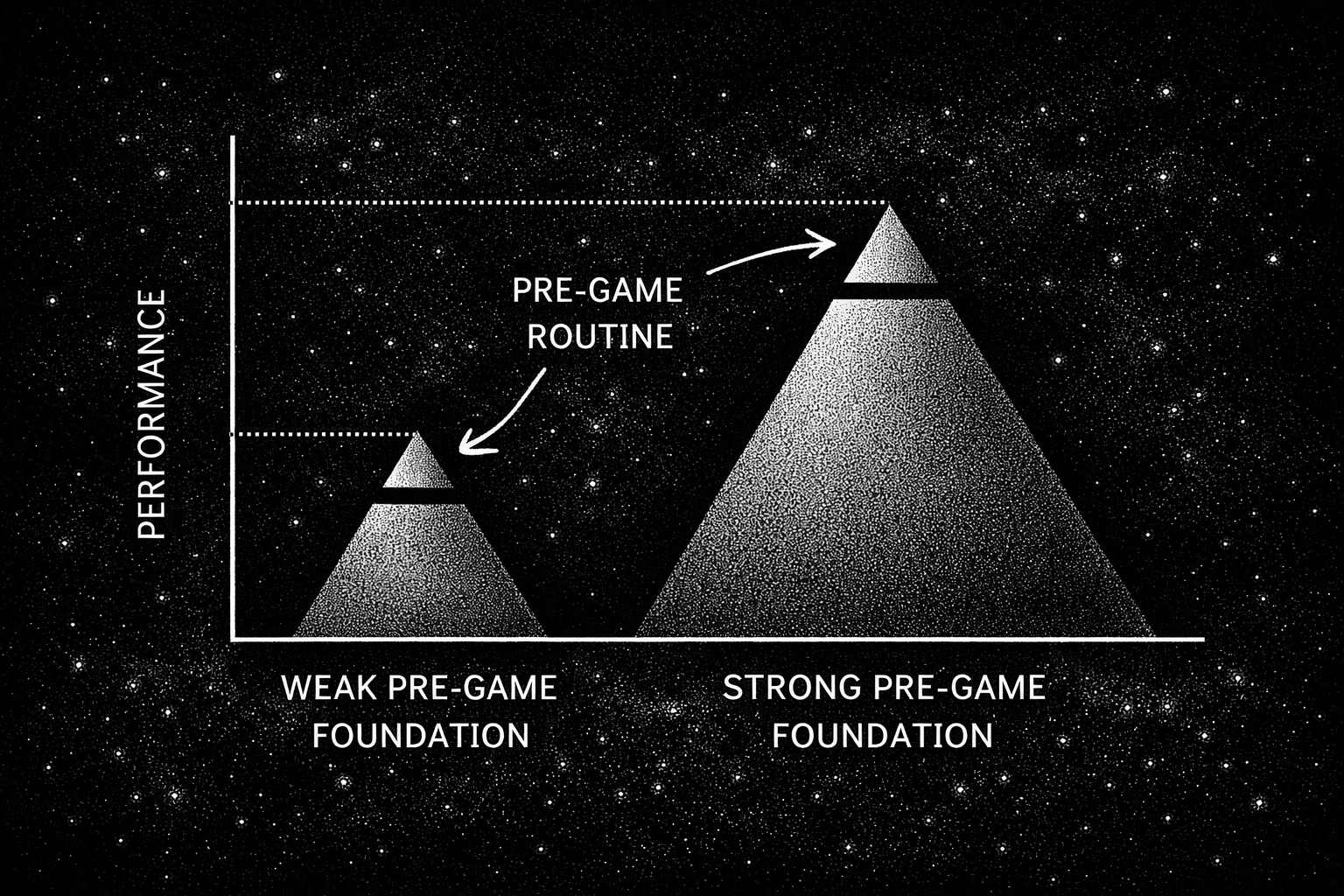
The pre-game foundation works through accumulation. Most of its effects are subtle day to day, but they become very clear under pressure.
Several underlying forces help explain why.
Small actions compound.
One rushed meal or one short night of sleep doesn’t feel decisive. Repetition changes that.
Over time, they accumulate into differences in energy, focus, emotional control, and recovery speed. That accumulation is what creates performance gaps between people who look similarly talented on paper.
Sleep, nutrition, stress management, and emotional regulation all work this way. You rarely notice their impact on a good day. You feel it most on hard days, when pressure is high and margins are thin.
Structure protects attention.
When basics are decided in advance, fewer decisions draw on limited mental resources. Structure preserves energy and reduces background noise.
This is especially important in high-performance environments, where decisions are constant and pressure is normal. Without structure, mental fatigue builds quietly throughout the day and shows up at the worst possible time.
Confidence grows from evidence.
When confidence is connected to preparation rather than outcomes, it becomes less volatile.
Outcomes fluctuate. Preparation does not. When confidence is tied to outcomes, it rises and falls with results. When it is tied to process, it becomes more stable and less reactive.
That stability is what allows confidence to survive bad games, mistakes, and pressure. Not because you expect to perform perfectly, but because you trust the work underneath.
Building a Foundation You Can Maintain
The key word is adherence: “adherence refers to the ability to consistently stick to a planned program or routine over time”.
A strong foundation is built through consistency rather than intensity.
Doing something consistently at a reasonable level beats doing it perfectly for a short period of time.
Miss a day, and the plan feels broken. Have a bad week, and motivation disappears.
Bad days are inevitable, they are part of the system. Progress continues when the response to a bad day is adjustment, not abandonment.
Fragile discipline depends on motivation and ideal conditions. Robust systems are designed to survive low energy, stress, and imperfect execution.
A few simple tools help protect adherence:
“If this were easy, how would I do it?”
“What is the next small step?”
Commit to doing it for only 25 minutes.
These questions and actions lower the barrier to start without lowering standards. They keep momentum alive when conditions are not ideal, which is most of the time.
Recovery as a Performance Skill
If stress isn’t taken care of it inevitably accumulates.
Each meeting, scrim, decision, and emotional demand adds to the total load. When recovery is missing, that load carries over from day to day. Performance may hold for a while, but it slowly declines as the system runs out of room to adapt.
This is the stress–recovery curve many people experience without noticing. Output stays high, effort increases, and eventually performance drops even though nothing obvious has changed.
Intentional recovery creates a clear boundary between effort and rest, allowing the system to reset. Small practices, done consistently, make a meaningful difference:
Short cooldown routines after intense sessions
Brief walks to reset attention
Journaling to unload cognitive and emotional residue
Screen and caffeine cutoffs to protect sleep quality
Intentional rest is what makes long-term performance possible. Without it, consistency erodes. With it, the foundation stays intact even during demanding periods.
Closing Thoughts
Pre-game routines still matter. They help you settle in and access what’s there.
What they reveal depends on what has been built beforehand.
Daily choices shape energy, focus, and emotional stability long before competition begins.
Structure create the conditions where creativity can emerge without being crowded out by fatigue or overload.
When the game starts, there are no hacks left.
No routine, mindset trick, or burst of motivation can replace what wasn’t built beforehand.
The routine still has value. It helps you access what’s there. But it can only reveal the foundation, not create it.
Build the foundation first.
Then let the routine do what it does best.
