Belief Is a Trainable Performance Skill
As coaches and players, we’ve all experienced situations like this in must-win games:
A player stops following calls and starts acting on their own
A player who never shotcalls suddenly takes over
A player makes an early mistake and feels “out” for the rest of the game
And, more often than not, the game slips away.
Why does this happen? Is it a lack of preparation?
Most top teams don’t lose under pressure because they didn’t prepare. In fact, the ones that struggle the most often worked extremely hard.
And yet, when pressure increases, that preparation doesn’t always show up.
Players hesitate. Systems get abandoned. Communication breaks.
Pressure increases stress, which reduces access to knowledge and preparation. The information is still there, but it becomes harder to reach when uncertainty and emotion rise. There is, however, a way to counter that effect and maintain access.
Belief.
Belief stabilizes the system when pressure hits. It helps individuals keep executing. It helps teams stay coordinated. It helps processes hold on.
Belief, trust, or confidence is often treated as something personal, almost innate to a player or team. But in practice, it functions as a trainable skill that directly shapes execution when it matters most.
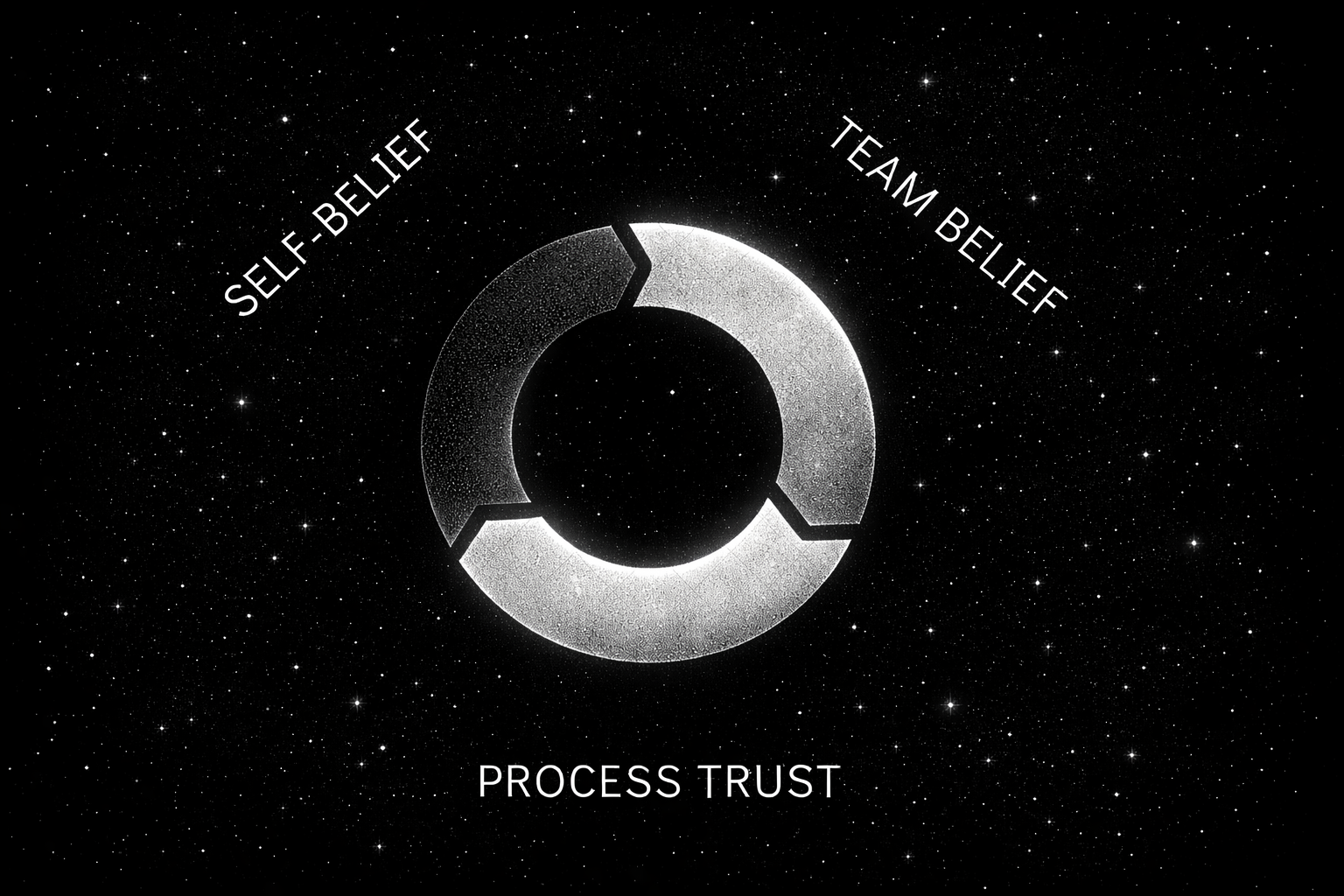
The Three Layers of Belief
In this article, we’ll break down the components of unbreakable belief at both the individual and team level, and how you can start building it within your team.
When you spend enough time around teams, you start noticing that belief shows up in different ways, at different moments.
There are three core layers that matter most:
Self-belief → How much a player trusts their own execution.
Team belief → How much players trust each other.
Process trust → How much the group trusts the coaches and the system they’re working inside.
When those layers support each other, execution stays consistent even in difficult moments. When one of them weakens, things don’t break immediately, but they start bending in small ways.
Self-Belief — “I Can Execute”
Some players arrive with a head start here. They’re naturally optimistic. They stay emotionally steady when things go wrong. Pressure doesn’t hit them as hard. That helps, especially early on.
Over time, self-belief has less to do with who the player is and more to do with the environment they’re in. A few recurring conditions keep shaping it, for better or worse.
Six of them show up again and again.
Demonstration of ability
Players trust themselves more when they’ve seen proof of their execution. Not highlights. Ordinary moments done well. Repeated execution compounds.
Social support and encouragement
Support matters too. Players notice when teammates and staff stay consistent after mistakes. Not through praise, but through presence. When support disappears the moment something goes wrong, self-belief starts feeling unstable.
Physical and mental preparation
Preparation is key. When routines are familiar, when pressure has been rehearsed, players enter competition feeling ready without needing reassurance. Structure reduces uncertainty before it has a chance to grow.
Coach’s leadership and expectations
Coaches shape players’ beliefs constantly. Through expectations. Through tone. Through what gets emphasized in reviews. Over time, players internalize those signals. When leadership feels steady, belief tends to follow. When leadership feels inconsistent, belief often does the same.
Role models
A rookie seeing a veteran succeed under similar conditions matters. A teammate executing under pressure, responding well after a bad game, or simply staying composed shows what’s possible. One calm performance can lift belief across the group.
Environmental comfort
And then there’s the environment itself. Familiar routines. Predictable structures. A sense of safety. When everything feels chaotic, self-belief has to work much harder just to stay intact.
Seen together, self-belief ends up looking less like a personality trait and more like the result of repeated conditions. That’s useful for coaches. It means belief can be supported deliberately, day by day, through how the environment is designed.
Team Belief — “We Can Execute Together”
You usually notice team belief after something goes wrong.
A lost fight. A missed call. A bad round. What happens next tells you a lot.
In teams where belief is present, players keep moving. They follow the next call. They stay connected.
That kind of trust is built through shared experience:
Long scrim days that don’t go well
Hard losses that are reviewed without panic
Tough discussions where alignment survives stress
Over time, players learn what mistakes lead to. When standards stay consistent, regardless of who made the error, trust starts to settle in. Players stop protecting themselves and start committing again.
You see belief start to shift when mistakes change the tone of the room. A coach focuses heavily on one player in review. Attention narrows. The intention might be improvement, but the signal lands differently. Commitment becomes cautious. Communication tightens.
Belief doesn’t disappear instantly. It thins out. Players still try, but they hesitate. They wait half a second longer. They choose safer options.
For coaches, this is where the “we” needs protection. When team belief holds, execution stays coordinated, even in messy situations. When it weakens, effort remains, but direction starts to drift.
Process Trust — “Our System Holds”
Process trust sits deeper than individual or team confidence. It’s the belief that the way the team prepares, decides, and reviews will still work even when things go wrong.
And it shows itself when results stop going your way.
The plan doesn’t land cleanly. Feedback gets noisy. Pressure rises. Teams with process trust keep operating inside their structure. Adjustments happen, but they’re measured. Decisions still follow a familiar logic.
You can feel it in how calm things stay.
This trust grows slowly through consistency across staff. Through clear priorities. Through decisions that are explained, especially the uncomfortable ones. Players don’t need everything to work. They need to understand why things are being done.
That understanding creates stability.
When process trust weakens, the shift is fast. Direction changes week to week. Systems that were practiced for months get dropped after a couple of bad games. The language changes. Hope replaces certainty.
At that point, preparation becomes harder to access. Players hesitate because the framework they relied on feels unstable.
From a leadership standpoint, process trust often decides whether preparation stays usable under pressure. Skills and practice create potential. Trust in the system is what keeps that potential available when conditions become difficult.
Teams that hold onto their process tend to navigate uncertainty with more consistency, even when outcomes fluctuate.
How Belief Collapses in High-Level Teams
Belief disappears through small changes in how people read situations, react to mistakes, and talk to each other under pressure.
At high levels, where preparation is rarely the issue, these breakdowns usually start inside the team and slowly creep in.
One common trigger is results. This could be in scrims, but particularly in official games.
It can start in different ways. A few players harshly criticizing a teammate. A coach hyper-fixating on one player during a post-game review. Or a player underperforming for a few days, starting to second-guess themselves, and slowly spreading that doubt to the rest of the team.
When confidence starts swinging with small losses, setbacks feel heavier than they should. A mistake stops being information and starts feeling like proof. Decisions feel riskier. Players hesitate.
Over time, that creates instability.
Leadership plays a big role here. When pressure rises, teams look for consistency:
Clear individual and collective priorities
Consistent messaging
Predictable standards
When those things shift without clear explanation from the coaching staff, trust begins to wobble. Players may still work hard, but uncertainty starts shaping their choices.
Another fragile point appears when individuals are singled out. Public criticism, even when framed as accountability, spreads quickly.
Commitment becomes cautious.
Communication tightens.
Players protect themselves by hiding or fighting.
In esports, this hits harder. There’s no bench. No reset. Everyone stays in the game together.
Overcorrection is another warning sign. After a loss, coaches sometimes change direction too sharply. Instead of refining what they’ve practiced, they throw it out. The effect is doubt in the process that was meant to provide stability.
Fatigue matters too. Burnout often looks like a loss of belief. When energy is low, negative interpretations sound more convincing, and effort feels heavier than usual. Without recovery, belief struggles to hold.
Across all of this, one pattern shows up again and again. When belief collapses, it’s usually driven by internal dynamics, not just external pressure.
It’s in the coaching staff’s hands to notice it early and give their teams a chance to respond before things start to slide.
Examples When Belief Fails
Over the years, I’ve worked with dozens of League of Legends, CS, and Valorant roster iterations. I’ve seen many teams fail, not because of talent or preparation, but because belief broke down.
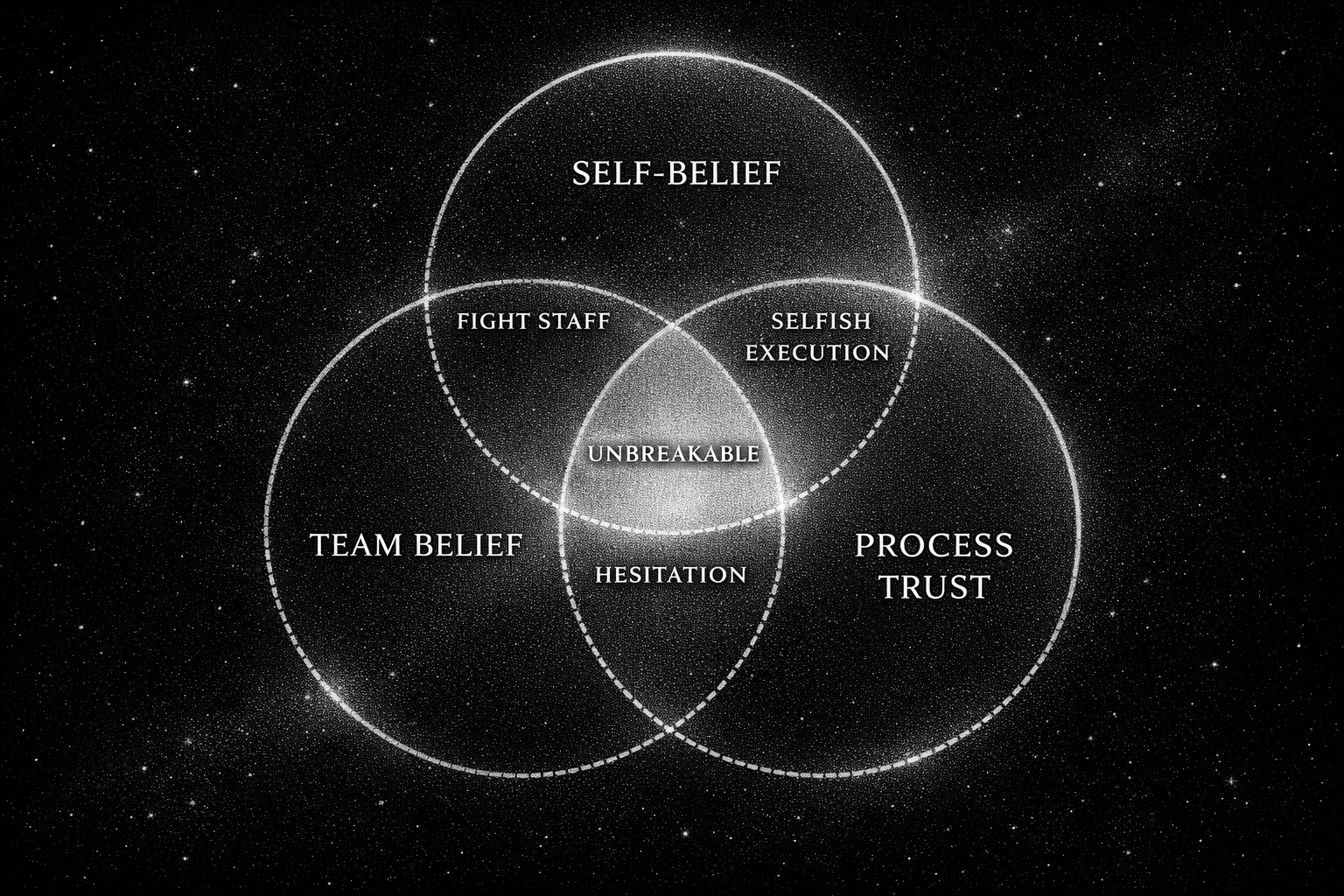
Here are three examples that illustrate how it happens.
Self-Belief + Process Trust – Team Belief = Selfish Execution
A couple of years ago, I worked with a very talented ADC. At the start of the split, he looked like the star player everyone hoped for.
After a few rocky weeks, the staff started noticing a pattern. Mid-game transitions were slow. The team arrived late to objectives and often had to retake from disadvantaged positions.
After reviewing multiple games, the issue became clear. The ADC was consistently delaying calls by one wave. This hadn’t happened at the beginning of the split, so the question was obvious. What changed?
Without realizing it, a belief had settled in. After a few bad games from some teammates, he started thinking, “If I don’t carry this team, no one will.” That belief pushed him to prioritize farm when he shouldn’t have.
The shift showed up elsewhere too. His teamfight positioning changed. He started making random shot calls that overrode clear team goals. All of it traced back to the same issue. He had lost trust in his teammates.
Self-Belief + Team Belief – Process Trust = Fighting the Staff
A few years earlier, I worked with a veteran support player. He was knowledgeable, the main shotcaller, and very strong-willed.
The roster looked strong on paper, but the first weeks were rough. From his point of view, the coach’s strategic direction was wrong. The losses became the proof he needed to confirm that belief.
He started criticizing the coach privately with another player. That player wasn’t fully convinced at first, but eventually agreed. Soon after, a third player was pulled into the same narrative.
He wasn’t lying outright. But he was filtering reality through a fixed idea. Losses were framed to blame the coach, not his own decisions or the team’s execution.
Over time, this turned into open conflict. The team eventually broke beyond repair. The staff didn’t realize what was happening early enough, and when they did, they didn’t know how to stop it.
Process Trust + Team Belief – Self-Belief = Hesitation
I’ve seen this situation several times. It almost always involves a strong-willed rookie coach and a talented rookie player.
The player has clear strengths, but the coach sees a glaring weakness. Instead of accepting it and building around it, the coach fixates on that flaw from the very beginning.
In his mind, it’s necessary. He believes the weakness will cap the team’s growth. It might be communication, coordination, aggression, or something else. Post-game reviews revolve around it week after week.
The player improves, but not fast enough.
After a few losses, the coach publicly blames the player for misexecuting the very thing they’ve been drilling. In front of the team.
The player is crushed. He’s been grinding nonstop and still can’t perform consistently. He starts believing the weakness is fatal, even though it isn’t. From there, confidence spirals.
Over time, his belief keeps dropping until it hits rock bottom.
The coach thought that weakness would cap the team’s growth. In reality, focusing on the weakness instead of building from the player’s strengths is what created the situation in the first place.
From that point on, rebuilding the player’s confidence becomes extremely difficult.
Closing Thoughts
Belief shows after a mistake. After a tough loss. In the middle of uncertainty, when decisions still need to be made.
In those moments, belief keeps execution connected. Players continue to act with intent. Teams stay coordinated.
Belief develops through daily behaviors. How preparation is designed. How feedback is delivered. How pressure is handled in reviews and conversations.
Over time, those behaviors shape how much trust exists when it matters.
For coaches and leaders, belief becomes part of the job. Tone, consistency, and clarity all contribute to the environment players operate in. The signals sent under pressure carry more weight than the ones sent when things are easy.
Belief is what allows teams to execute when pressure is highest.
